Application support
Payload changes, route adjustments and seasonal peak reviews stay tied to the original assumption register.
Application, controls, EHS and operations reviewers work from the same payload, route, interface and recovery record—from RFQ screening through SAT closure.
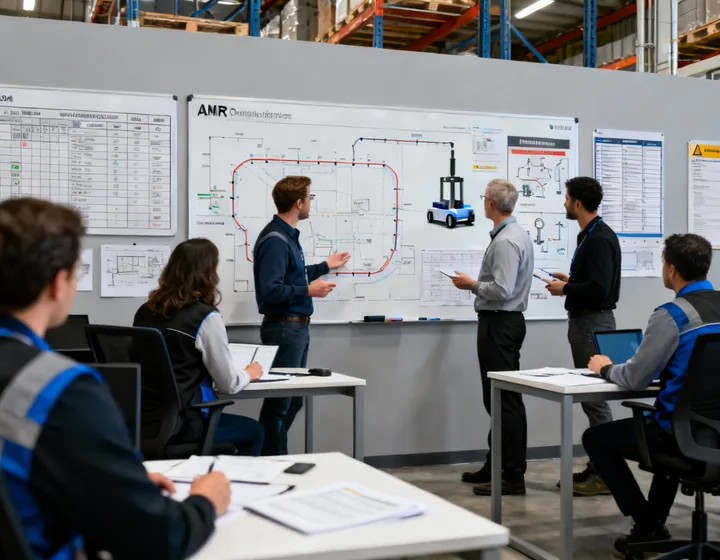
Planning ranges such as founding year, headcount or geography in brand records are internally generated working context, not independently verified public claims. The useful evidence is the project matrix that assigns WMS, WCS/WES, PLC, fleet management and site utilities.
| Layer | Typical ownership | Evidence expected |
|---|---|---|
| WMS | Order and inventory decisions | Task creation rules, cancellation and priority change logs |
| WCS / WES | Wave orchestration and zone release | Timeouts, reroutes and buffer occupancy thresholds |
| Fleet manager | Robot assignment, traffic and charging | Conflict resolution, dock dwell and exception codes |
| PLC / safety | Field devices and stop chains | Safety validation records and restart authority |
| Site utilities | Power, network and facility access | Outage classification and excluded downtime rules |
Throughput acceptance records SKU and order structure, run duration, replenishment demand, buffer occupancy and exception recovery. FAT confirms the available factory-representable scope; SAT demonstrates integrated behavior at the installed site, including shared-aisle pedestrian rules and charging release.
Payload changes, route adjustments and seasonal peak reviews stay tied to the original assumption register.
Interface tickets require the owning system, alarm code, timestamp source and the last known safe state.
Operators receive inspection points, prohibited modifications and the return-to-service checklist used during SAT.
Remote diagnostics cannot replace on-site access where guarding must be opened, a load must be stabilized or a robot must be removed from a congested aisle. Response time and restoration time are tracked as separate clocks.
Engineering review freezes the SKU sample, peak window and congestion assumptions used for fleet sizing.
Review delivery gatesPre-shipment checks capture robot behaviors that can be staged, plus open interface deviations.
Inspect factory scopeOn-site witnesses cover aisle geometry, safety fields, live interfaces and controlled restart drills.
Plan site acceptanceSupport clocks separate notification, access, spare release and verified return-to-service.
Open the Uptime Plan